竹中半兵衛という武将
demeburogu
侍旅

Wisdom for manufacturing learned from warlords of the Sengoku period
In 1560, Oda Nobunaga defeated the powerful Imagawa Yoshimoto, who commanded an army of 25,000 men, with only 2,000 soldiers of his own.
How was Nobunaga able to win the famous Battle of Okehazama against such overwhelming odds?
The answer lies in his ability to read maps accurately.
Before the battle even began, Nobunaga had already identified and controlled the key strategic points on the map.
To isolate the Imagawa forward bases of Narumi Castle and Odaka Castle, he strategically placed forts such as Zenshoji Fort and Nakajima Fort at precise locations.
These positions effectively cut off the enemy’s supply lines and communication routes, forming a tight encirclement.
Because of this fortress placement based on careful map reading, the Imagawa army—despite its size—was unable to move freely.
They were gradually forced into a narrow route toward the Okehazama area, exactly as Nobunaga had planned.
Nobunaga thoroughly understood the terrain, accurately predicted the enemy commander’s position using maps and intelligence, and launched a surprise attack along the optimal route.
Without the ability to read maps, this victory would have been impossible.
The same principle applies to modern manufacturing.
If you cannot read technical drawings, you cannot create precise products.
Technical drawings are the maps of manufacturing.
Nobunaga’s words are not just a declaration of war. They represent the spirit of “perfect preparation and precise execution.”
Applying this to manufacturing:
In other words, one way of thinking is to “create perfect products with precise technology and spread them around the world.”
Nobunaga’s lesson:
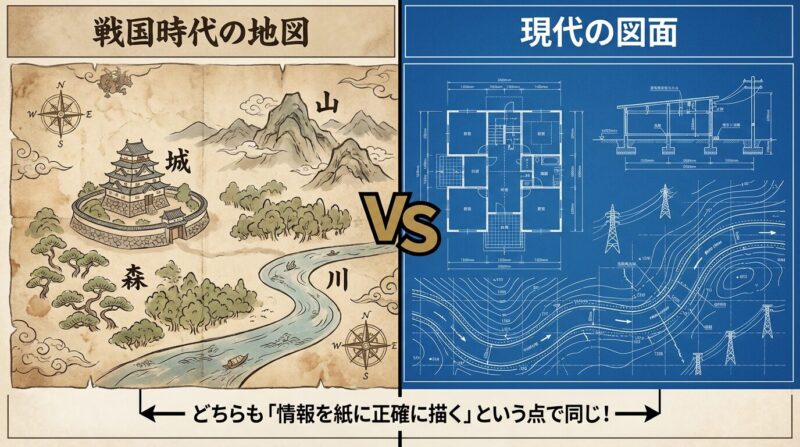
Just as warlords of the Sengoku period looked at maps before going to battle, people in the manufacturing industry look at blueprints.
What maps and drawings have in common:
| Map of the Sengoku period | Modern drawings |
|---|---|
| Location of the castle | Part location |
| Distance (◯ri) | Dimensions (◯mm) |
| River and mountain shapes | River and mountain shapes |
| North direction | Arrow pointing to the front |
Imagine you work in a factory that processes parts.
If you don’t have a drawing:
If you have a drawing:
Drawings are “words.”
Anywhere in the world, even if you don’t speak the local language, you can make the same product as long as you can read the blueprints.
When Nobunaga built Azuchi Castle, how did the craftsmen share the same vision?
Answer: I drew a picture from three angles.
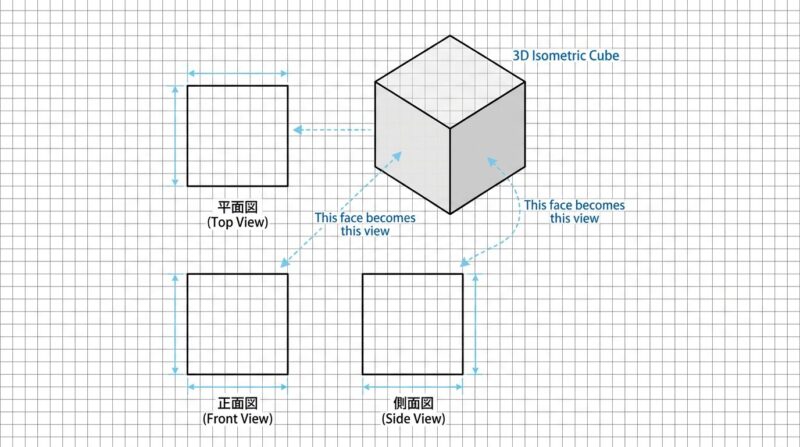
This is the basis of third angle projection.
Third angle projection = A method of viewing an object from three directions and drawing it on a flat surface
Three perspectives:
Example: cube (dice shape)
Viewed from the front: ■ (square)
Viewed from the side: ■ (square)
Viewed from above: ■ (square)
→ They all look the same! It’s only when you see all three together that you realize they’re cubes.
Question: What shape is the following drawing?
Front view: 50mm x 50mm square
Side view: 50mm x 50mm square
Plan view: 50mm x 50mm square
Answer: A cube with sides of 50 mm (dice shape)
Key Takeaways:
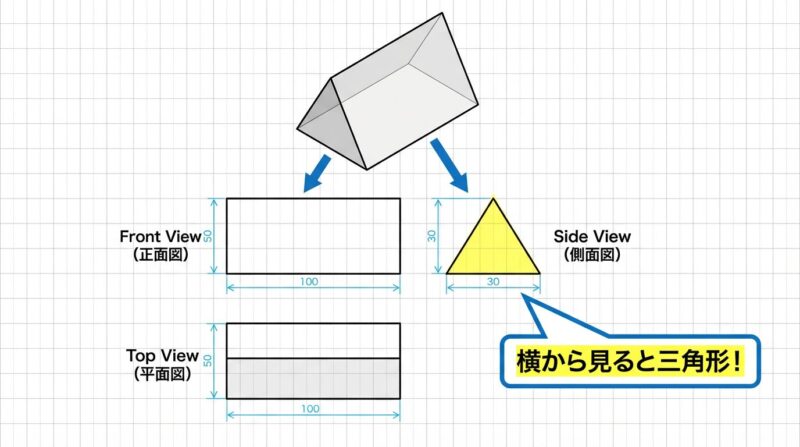
Question: What shape is the following drawing?
Front view: 40mm x 30mm rectangle
Side view: Triangle with base 40mm and height 30mm
Plan view: 40mm x 60mm rectangle
Answer: Triangular prism
Reading tips:
→ Combining three makes a “triangular prism”
important:
“It looks like a triangle when viewed from the side!” → This determines the object’s characteristics
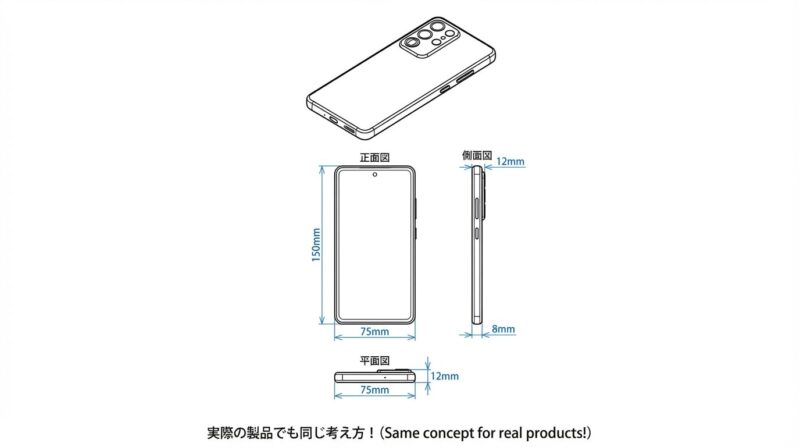
Actual product: Smartphone (8mm thick)
Front view:
Side view:
Floor plan:
What this drawing shows:
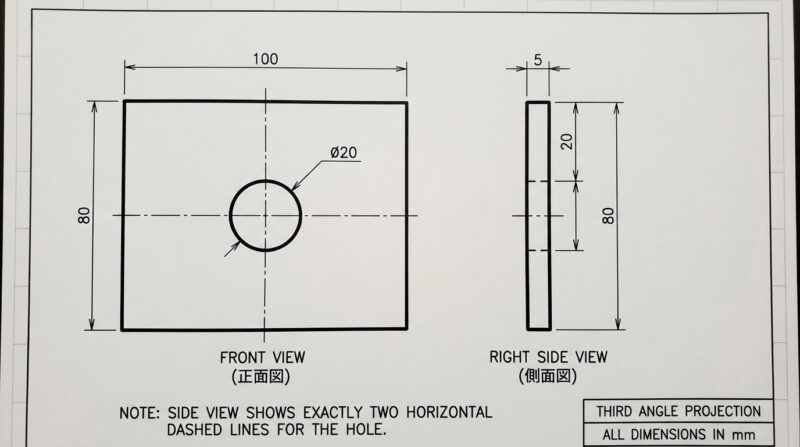
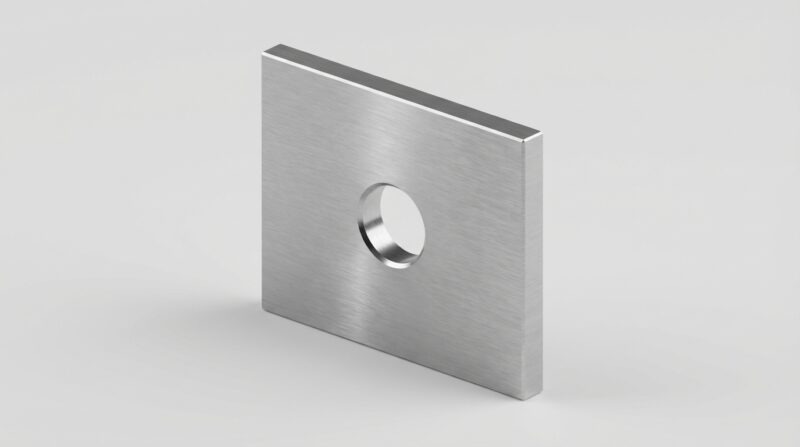
Question: Read the drawing of the perforated board.
Front view:
Side view:
Floor plan:
Important symbols:
Reading:
各部面取りあり
Just as warlords of the Sengoku period could not fight without maps, accurate products cannot be made without blueprints.
These three things will help you fully understand the shape of an object!
Nobunaga’s words: “Tenka Fubu”
→ Make your career a success with the weapon of technology!
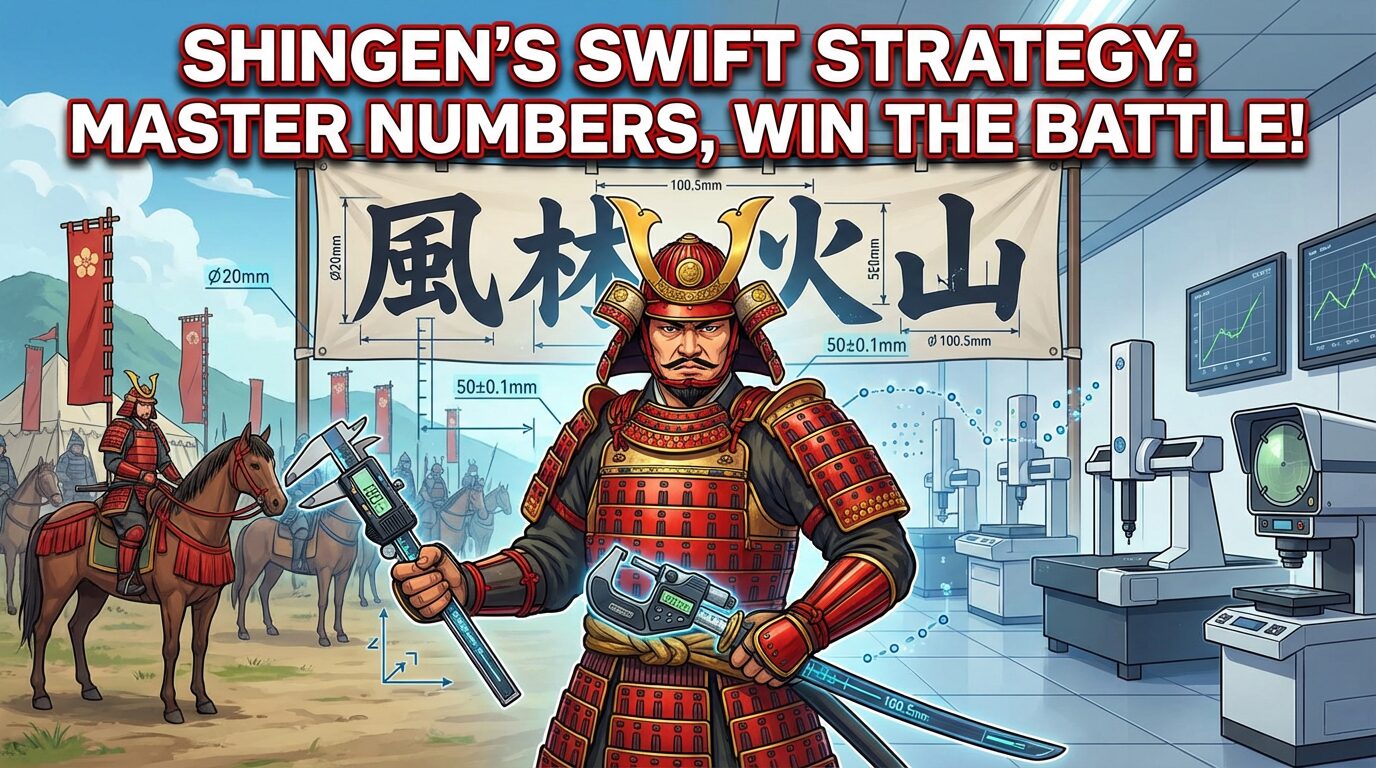
Title: Takeda Shingen’s Fuurinkazan – If you can read numbers you can win!
Contents:
Takeda Shingen’s famous quote:
“People are castles, people are stone walls, people are moats”
→ Accuracy of numbers makes the product strong
Stay tuned!
Objects: erasers, smartphones, books, cups, etc.
assignment:
Goal: To experience “The shape of an object can be fully understood with three diagrams”
Where to look?
If you find it:
What we teach:
“The drawing is a picture seen from three directions.”
By teaching:
Week 2 : Learn how to read numbers (measurements)
Week 3: Learn drawing symbols
Week 4: Gain practical skills through comprehensive exercises
Oda Nobunaga took control of the country thanks to his ability to read maps.
Your ability to read blueprints can open up your future career.
First Step: If you’ve made it to the end of this article, you’ve already started.
Next Step: Take on this week’s challenge mission.
And: See you in Week 2!
Next episode: Week 2 – Takeda Shingen’s Fuurinkazan